

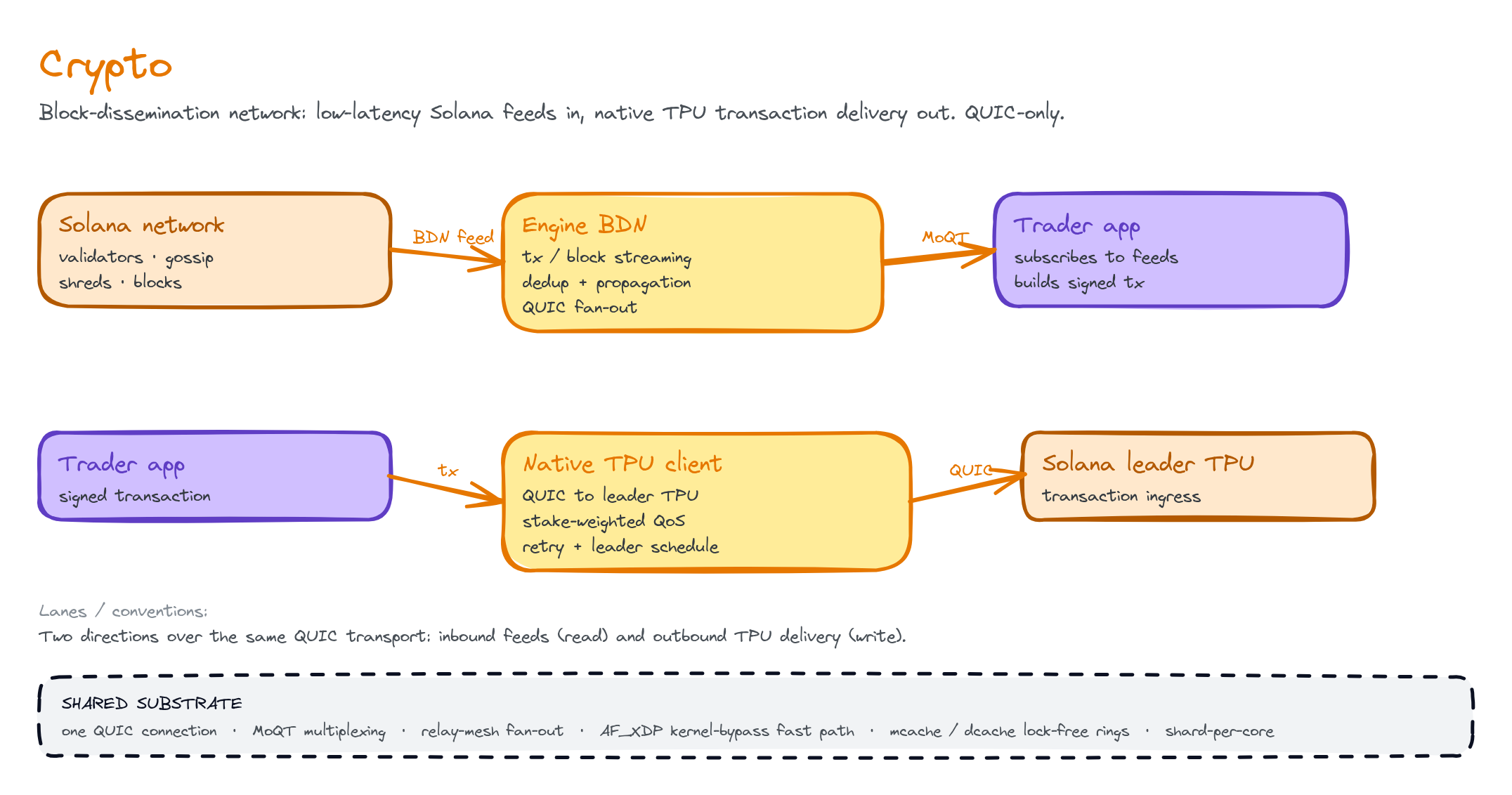
Crypto BDN data flow — feeds in over MoQT, transactions out over QUIC to validator TPUs.
- Feeds in — the edge ingests low-latency Solana data (slots, recent blockhash, priority fees) and republishes it as named MoQT tracks. Traders subscribe over QUIC. They read each update the moment the relay fans it out.
- Transactions out — you send a signed transaction to the BDN. The BDN deduplicates the transaction and fans it out across the edge mesh. It lands the transaction directly on the current and next leader validators’ TPU over Solana’s native QUIC protocol.
ALPN solana-tpu carries the
leg out to validators. There is no gRPC and no WebSocket on the client edge.
The service refuses clients that cannot negotiate QUIC. There is no TCP
fallback.
No typed SDK ships for crypto yet. Today you use the BDN in two ways: the
QUIC submit/feeds HTTP/3 API (any HTTP/3 client), and the raw MoQT client
(
@clutchcall/sdk/moqt) to subscribe to feed tracks. A dedicated typed
Crypto client is a Preview — see SDK methods. Everything
below describes what runs today.When to use it
Land transactions faster
Submit a signed Solana tx once. The BDN fans it out and lands it on several
upcoming leaders’ TPUs in parallel, not through a single RPC hop.
Low-latency trader feeds
Subscribe to slot / blockhash / priority-fee tracks over QUIC. The edge
pushes each update the instant it sees it. You do not poll an RPC node.
Bring your own ingest
Set the ingest to your own gossip/Geyser endpoint. This publishes a private
feed track scoped to your organization.
Co-located edge mesh
A root ingests and fans out to edge relays near the validators that they
land on. This shortens the network path between you and the leader.
Wire model
The BDN is a small set of MoQT track namespaces plus two HTTP/3 submit paths.Feed tracks (BDN → you)
Feeds are ordinary MoQT frame tracks. Each track is a namespace + name that carries opaque binary objects. The relay mesh fans out these objects. The public Solana mainnet feed lives under thesol/feed/mainnet namespace:
The BDN publishes a private feed (your own ingest endpoint) under
sol/feed/<orgId>/…. Only your organization can see it. You subscribe to any of
these tracks with the raw MoQT client — see
Subscribe to a feed track.
Submit paths (you → BDN → validators)
You deliver a signed transaction over HTTP/3 with the raw tx as anapplication/octet-stream body. There are two routes:
For both routes,
leader=auto / host=auto resolves the leader schedule
automatically. Pass an explicit host:port to target a specific validator TPU.
The first 64 bytes of the transaction are its Solana signature. The BDN uses
them as its dedup key. Thus, if you re-submit the same tx across edges, it
lands at most once per leader.
Lanes & QoS
Finding the endpoint
Clients find the QUIC port through a DNS HTTPS resource record on the crypto host (alpn=h3, with the QUIC port in the record). The rest of the platform
uses the same mechanism for HTTP/3 endpoint discovery.
You discover feed tracks when you subscribe to a namespace prefix. The relay
holds the subscribe even for a track that is not announced yet. Thus you can
subscribe to a private feed before your ingest publishes its first slot.
How it works
The BDN runs on the same shard-per-core engine as every other modality. You inherit its kernel-bypass data path. Thus your feeds arrive the instant the edge sees them, and your transactions leave the box with minimal overhead.1
Ingest (root)
The root node subscribes to Solana data on a single shard. The source is a
public RPC
slotSubscribe or your own gossip/Geyser endpoint. The root
stamps each update into a MoQT frame object.2
Fan-out (relay mesh)
The relay mesh fans each feed object and each submitted tx to every
subscribed edge. It uses one QUIC connection per peer. Cross-shard hand-off
uses lock-free mcache / dcache rings. Thus a feed never crosses a lock
to reach a subscriber.
3
Land (edge → TPU)
Each edge resolves the leader schedule (
getLeaderSchedule). It opens a raw
QUIC connection to the leaders’ TPU endpoints and writes the transaction.
The NIC fast path is kernel-bypass, with per-core flow steering and
zero-copy buffers. Thus the tx leaves the box with minimal kernel
overhead.Next
SDK methods
Subscribe to feeds with the MoQT client. Read about the Preview typed
Crypto surface.Cookbook
Do short tasks: subscribe to a track, submit a tx, target a leader, and
tune dedup.
Recipes
Build end-to-end examples: a feed-driven submitter and a private-feed
consumer.