

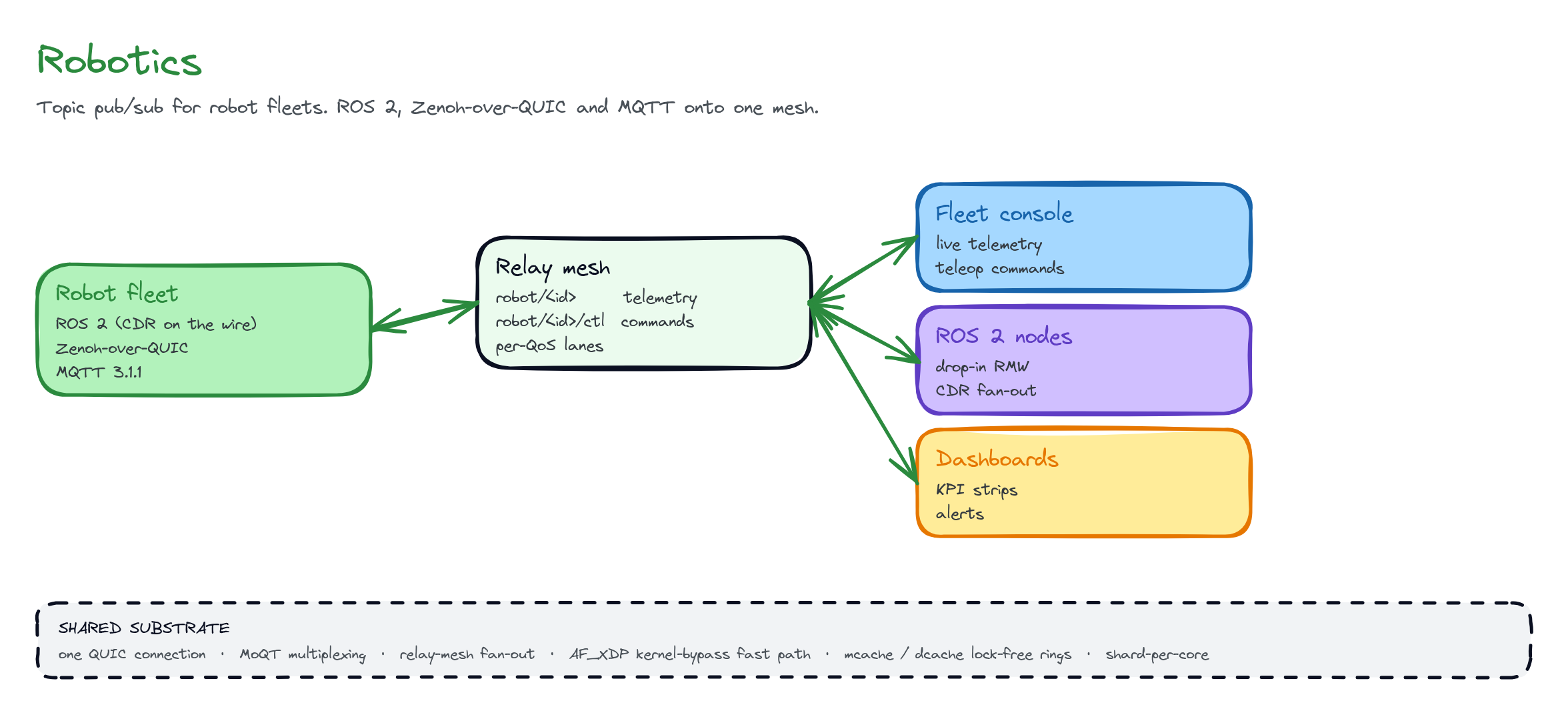
Robotics: telemetry up, commands down. One MoQT track carries one topic. The relay mesh fans out the tracks.
(tenant, robot) pair. Two namespaces are built in.
The two directions never collide, and a controller cannot accidentally
subscribe to the robot’s own announce:
What you can build
Fleet telemetry
Stream odometry, LIDAR, battery, and pose from hundreds of robots to a
cloud dashboard or a recorder. Each robot uses its own
robot/<id>
namespace.Teleoperation
Drive a robot from the cloud.
cmd_vel and goal commands flow down
robot/<id>/ctl on a low-latency lane. Telemetry flows back up the same
session.Cross-language demux
A TypeScript dashboard and a Python analytics worker subscribe to the same
CDR track. The type-name prefix lets each one pick its own decoder.
Drop-in ROS 2 transport
Replace the local middleware with a ClutchCall-backed transport. A
ROS 2 node then reaches the fleet over WAN-grade QUIC with no code change.
Three transports onto the mesh
A robot can reach the relay mesh in three different ways. All three use the same namespaces and the same type-name-prefixed wire frame. Producers and consumers interoperate, whatever way each one connected.- ROS 2 (CDR)
- Zenoh-over-QUIC
- MQTT 3.1.1
This is the native path. A ROS 2 node serializes its messages to CDR
(the DDS Common Data Representation). The raw CDR bytes travel on the
track unchanged. The SDK prefixes the type name
(
nav_msgs/msg/Odometry). A subscriber anywhere can then give the
payload directly to a CDR decoder.The on-the-wire frame is identical for each type of connection. The transport
is a property of how a peer reached the mesh, not of the data. Thus a CDR
publisher, a Zenoh node, and an MQTT sensor can all feed one subscriber.
Wire model & track conventions
Each robot maps to a pair of MoQT namespaces. A topic becomes a track name under the relevant namespace. One MoQT track carries one topic.
Each published message opens its own MoQT group (one discrete ROS message per
group). The relay holds a small recent-group window, so a late subscriber
gets the latest frames. This window is the closest analog to a ROS 2 history
depth.
Type-name-prefixed CDR frame
Every object on the wire is a self-describing envelope:- The 2-byte big-endian length limits type names to 65 535 bytes. Real ROS 2 names fit in approximately 64 bytes.
- The CDR payload is opaque to the SDK. You give the SDK the bytes that
your DDS, Zenoh, or
serialize_messagealready produced. - The prefix makes the stream cross-language. A subscriber gets
(cdr, typeName)and routes the payload to the matching decoder with no schema registry.
QoS → lanes
ROS 2 QoS hints map onto MoQT lanes at the relay. You pass aqos profile
when you create a publication. The relay routes and admits the track by the
resulting capability.
- Reliable uses subgroup streams. Delivery is guaranteed and in order per publisher. Use it for commands and for telemetry that you cannot drop (a map update, a goal).
- Best-effort uses QUIC datagrams. Latency is lowest, but delivery is lossy. Use it for high-rate sensor streams (pose, LIDAR), where the freshest sample wins.
- transient_local makes the relay retain the last group(s). A subscriber that joins late immediately receives the most recent value. This is the analog of a latched MQTT retained message.
- depth limits the per-track group window that the relay holds for late subscribers. This matches ROS 2 keep-last history.
write.
Drop-in ROS 2 transport
A robot does not have to know that the relay exists. Its nodes publish and subscribe exactly as before, while their topics travel off-box on ClutchCall. There are two ways to do this. They differ in how much of the local stack you replace:- The RMW (
rmw_clutchcall_cpp) — a real ROS 2 middleware that replaces DDS/Zenoh. After oneapt installand one env var, every topic, service, and QoS event uses QUIC, with no local DDS at all. This is the recommended path for a full ROS 2 stack that goes WAN-native. - The bridge (below) — a small native process that runs beside DDS/Zenoh and mirrors selected topics onto MoQT. Keep local DDS for on-robot traffic. Bridge only the topics that leave the box.
The bridge
The bridge presents itself as an ordinary middleware transport. Local nodes publish and subscribe their topics exactly as before. The bridge mirrors those topics into and out of MoQT:1
Local nodes stay local
Nodes talk to the bridge over the standard middleware interface: DDS or
Zenoh on the robot’s loopback. No application code changes.
2
Bridge mirrors topics
For each configured topic, the bridge subscribes locally and republishes
the raw CDR onto a
robot/<id> telemetry track. The bridge also
subscribes to a robot/<id>/ctl command track and republishes onto the
local graph.3
Mesh fan-out
The relay fans each telemetry frame out to every cloud subscriber. It
routes each command down to the addressed robot. Transport is WAN-grade
QUIC, across NAT, with one auth token.
This page describes the bridge by role, not by file. From the robot’s
point of view, it is “the transport that carries my topics off-box”. From the
cloud’s point of view, it is “the fleet ingress”. The SDK in
SDK Methods gives you the same pub/sub
surface programmatically when you want to bridge selected topics yourself.
How it works
You get one connection per robot, one token, and no broker to operate. A single host still fans a high-rate fleet out at line rate.- One connection, many tracks. Telemetry and commands for a robot share one QUIC session. You open and authorize a single connection. MoQT multiplexes every track over it. The relay mesh fans the tracks out to subscribers across hosts.
- One token. The tenant token that authorizes voice / streams / games authorizes the fleet. You need no separate broker credentials.
- No broker to run. The relay mesh is the fan-out. There is no MQTT broker or DDS discovery domain to operate in the cloud.
- Line-rate fan-out. High-rate fleets stay fast. The engine is shard-per-core with a kernel-bypass NIC fast path, lock-free mcache / dcache rings between shards, and io_uring for async I/O. A single host fans out without copies through the kernel network stack.
Related
- SDK Methods — the typed
Roboticssurface. - Cookbook — short task-oriented snippets.
- Recipes — end-to-end worked examples.
- Realtime Tracks — the MoQT primitive underneath.