

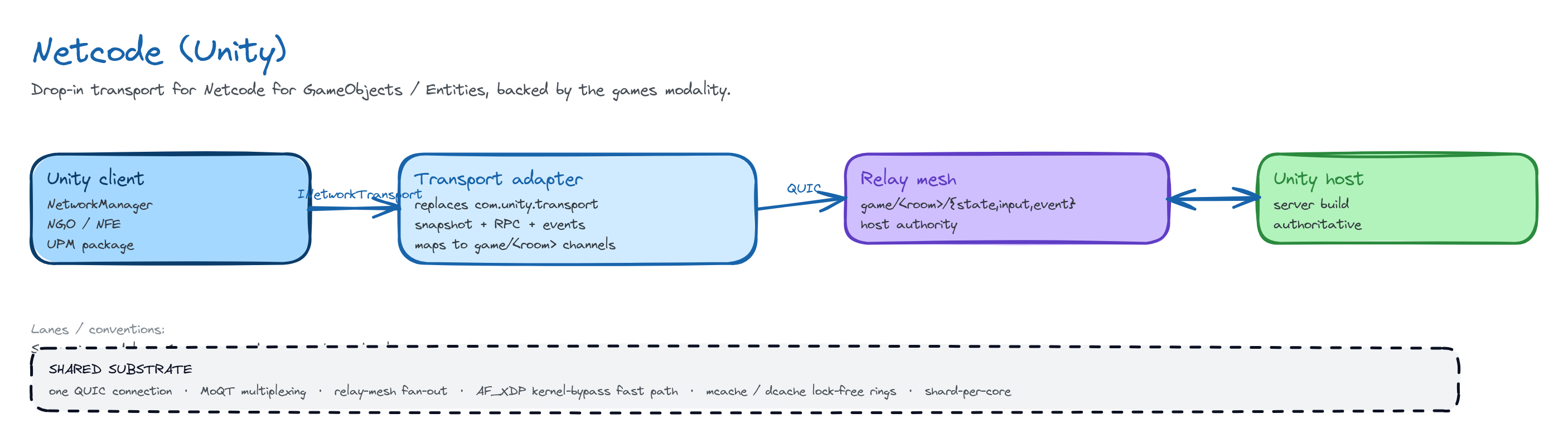
The Unity transport swaps UTP's INetworkInterface for a QUIC + MoQT pipe through the relay mesh.
com.clutchcall.transport. It is a replacement for
com.unity.transport (UTP). Your Netcode for GameObjects or
Netcode for Entities project then delivers over a global relay mesh instead
of bare UDP. Your NetworkManager / DOTS code stays unchanged. Every Unity
Netcode sample (server-authoritative, client prediction, ECS sync) works after
you swap one prefab.
The transport implements UTP’s INetworkInterface. Thus Connect / Send /
Disconnect behave the way you expect. Reliable channels map onto MoQT
subgroup streams. Unreliable channels map onto QUIC datagrams. Peer
discovery uses a namespace subscription on the relay.
If you build a non-Unity game, or if you want explicit control of the channels,
use the Games SDK directly. Use the Unity
transport when you have a Netcode project and want to keep its
NetworkManager / DOTS code unchanged.When to use it
Existing Unity Netcode project
You have a Netcode for GameObjects / Entities game. You want global relay
delivery, and you do not want to rewrite your networking layer.
UTP-shaped semantics
You want
Connect, Send, GetCurrentRtt, and MaxPayloadSize to behave
like UTP, but over a QUIC pipe with reliable + unreliable channels.Global edge fan-out
Players connect to the nearest relay POP. The mesh fans state and input
between regions. You do not operate self-hosted relay servers.
One token, one connection
The transport authenticates with the same ClutchCall token as every other
modality. It multiplexes over a single QUIC connection.
Wire model
The transport reproduces UTP’s two-channel model on top of the MoQT track primitive. Internally, the host opens an authority namespace. Each client publishes its own discovery namespace plus per-peer reliable and broadcast channels.
The relay forwards a namespace announcement only to sessions that subscribed to
a matching prefix. Thus namespace subscription is the natural join/leave
channel. A client appears in the host’s roster the moment it announces. It
disappears when its session drops.
Lanes & QoS
The two UTP channels map to the same QUIC lanes that the games modality uses:- Reliable lane — a per-peer frame track over subgroup streams. Delivery is in order, with retransmits. Use this lane for messages that you cannot drop.
- Broadcast lane — a game-state-style fan-out frame track from the authority to all peers. It also uses subgroup streams when you request reliability.
- Unreliable lane — each frame flagged as datagram travels in a single QUIC DATAGRAM. There is no head-of-line blocking and no retransmit. The latest frame wins. Use this lane for your tick-rate state and input snapshots.
ECS racing sample
The Unity-provided ECS-Network-Racing-Sample runs end-to-end over ClutchCall after the transport swap. After you assign the host and client roles, the[Server] / [Client] “Go in game” connection
lifecycle completes. Netcode assigns NetworkId. Tens of thousands of
datagrams flow through the relay per match. They all use the unreliable lane.
Reliable spawns and RPCs use subgroup streams.
Limitations
How it works
You keep your UTP surface. The transport does the rest. Every UTP call forwards into a shared, language-agnostic star-session layer in C++. Thus the same host-plus-N-peers shape (reliable + unreliable + discovery) backs any engine integration, not just Unity. The Unity package is a thin managed wrapper around that session: a QUIC-datagram pipe plus synthetic UTP endpoints. To integrate a non-Unity engine, you implement a small set of engine-side hooks: discovery, RTT, max-datagram, capture-time telemetry, and the datagram-lane mapping. The rest is reused.Global rooms with no server of your own
Global rooms with no server of your own
Two players on different continents share one logical room. Neither player
runs a server. Every player holds one QUIC connection to its nearest
relay POP and speaks MoQT (Media over QUIC Transport) over it. The
relay mesh fans state and input between regions. Reliable channels are MoQT
subgroup streams. Unreliable channels are QUIC datagrams. Both use the same
connection.
Tens of thousands of datagrams per match, no stutter
Tens of thousands of datagrams per match, no stutter
A single relay node fans room traffic without GC pauses or lock contention.
The relay is a shard-per-core (thread-per-core) reactor. Each core owns
a slice of connections, with no cross-core locking on the hot path.
Lock-free SPSC / SPMC ring buffers hand work between stages.
Predictable sub-millisecond relay latency under load
Predictable sub-millisecond relay latency under load
On the relay’s data plane, packets move through a kernel-bypass NIC
path. The path steers room traffic into a per-core buffer pool. The engine
reads and writes frames zero-copy, without a syscall per packet. Thus
processing latency stays predictable, even under load.
One token, every modality
One token, every modality
The token that you set in the transport inspector authorizes the QUIC
session. The same token shape works across every ClutchCall modality.
Thus a title that also uses voice chat or live streaming reuses one
credential and one connection.
Related
SDK methods
This page covers the install, the ClutchCallTransport component, and the
inspector surface.
Cookbook
This page has task snippets: swap UTP, set lanes, read RTT, and run a
headless server.
Recipes
This page has end-to-end examples: the ECS racing sample and a headless
dedicated server.
Games modality
This transport is a UTP shape over the pure-MoQT games modality.