

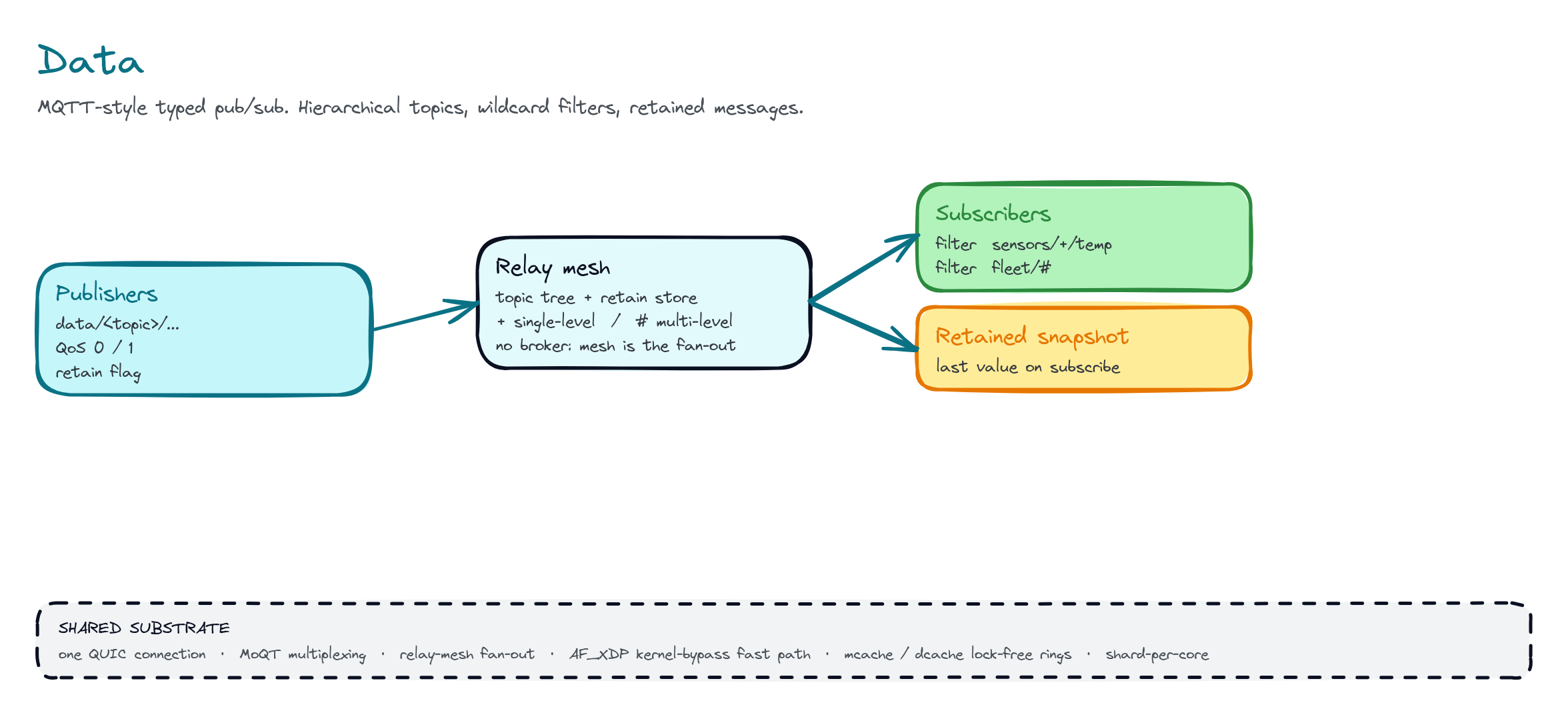
Data: hierarchical topics fan out through the relay mesh — no broker in the path.
+ (one segment) and #
(rest) wildcards, retained messages, and a choice of reliable or lossy
delivery. All of this comes from one typed client.
Use it for device telemetry, fleet state, config distribution, application
event buses, and presence. It fits any “many publishers, many subscribers,
routed by topic” shape.
At a glance
No broker
The relay mesh fans messages out. Every modality shares one operational
model. You run nothing extra.
MQTT-style topics
Topics are hierarchical (
a/b/c) with + (single segment) and #
(multi-segment, trailing) filters. The semantics are the same as
MQTT 3.1.1.Two lanes
A lossy QUIC datagram lane serves high-rate telemetry. A reliable ordered
lane serves events that must arrive. Pick the lane per message.
Retained messages
Publish current state once. Every late-joining subscriber gets the last
retained value on attach.
Wire model
AData client binds to a stable clientId and speaks hierarchical topics.
Each published message carries a small header in front of your opaque payload.
The header holds the publisher’s clientId and the full topic.
Subscribers can thus filter and attribute messages without a track per
publisher.
Uint8Array / bytes). On the substrate, the SDK maps one MoQT track
per top-level topic segment under the data/<segment> namespace:
sensors/* traffic shares one track. All home/* traffic shares another
track. The publisher sends the full topic in the frame header. The SDK filters
the rest of the path MQTT-style on the subscriber side. The MoQT capability tag
for the track is data.pubsub.
The top-level segment of a filter must be concrete.
sensors/+/temp is
valid. +/room1/temp and # are not valid. The top-level segment selects the
track. A wildcard there would subscribe to every namespace at once. Pick a
concrete first segment. Use wildcards below it.Topic filters
The semantics are the same as MQTT 3.1.1:
The rules match MQTT:
+matches exactly one path segment.#matches the rest of the path and must be the final segment of the filter.- An exact topic string matches itself.
Lanes and QoS
Every publish picks a lane:- Datagram lane (default)
- Reliable lane
reliable: false (the default) rides the QUIC datagram lane. The lane
is lossy and unordered, with the lowest latency and no head-of-line
blocking. Choose it for high-rate sensor readings. Choose it for any
signal where the freshest value matters more than delivery of every value.DataMessage carries a retained flag. A subscriber uses the flag to
tell a retained bootstrap message from a live message.
Retained messages
The relay caches a message published withretained: true, keyed on
(namespace, topic). A subscriber whose filter matches that topic receives
the last retained value immediately on attach, before any live messages.
This is the canonical “current state” pattern:
devices/device-7/state (or devices/device-7/#) gets
that payload on attach. To clear a retained topic, publish a zero-length
payload with retained: true. Do this typically on clean shutdown. A
dashboard then reads “offline” without a wait for a heartbeat timeout.
Per-client demux
Every message carries the publisher’sfromClientId. A single subscriber can
thus fan in from a whole fleet and still know which device sent each message.
There is no track per device. One subscription and one filter handle the
“thousands of devices report to one dashboard” shape.
When to use it
Reach for data when…
You want topic-routed pub/sub, MQTT wildcards, retained state, or a typed
event bus. You do not want to run a broker.
Reach elsewhere when…
You need media tracks (use voice / streams), tick-rate game channels
(use games), or ROS 2 / DDS QoS semantics (use robotics).
How it works
You skip the broker. The same QUIC connection and ClutchCall relay mesh that you already use for voice, streams, games, and robotics is the fan-out. You deploy, secure, and scale nothing extra. To add data to an existing app costs one more topic namespace, not one more server. This gives three results:- One auth path. The same tenant token that authorizes voice, streams, and
games authorizes the data plane. The token’s claims carry the tenant and the
clientId. - Native browser client. There is no MQTT-over-WebSocket bridge. The browser SDK speaks the same wire as your devices over WebTransport.
- Mix with other modalities. A game client that publishes match telemetry, or a voice app that publishes call events, reuses its existing QUIC connection and token. There is no second stack.
Related
- Realtime Tracks — the MoQT primitive underneath.
- Modalities overview — the shared substrate and the full set.
- SDK Methods — the typed
Datasurface.