

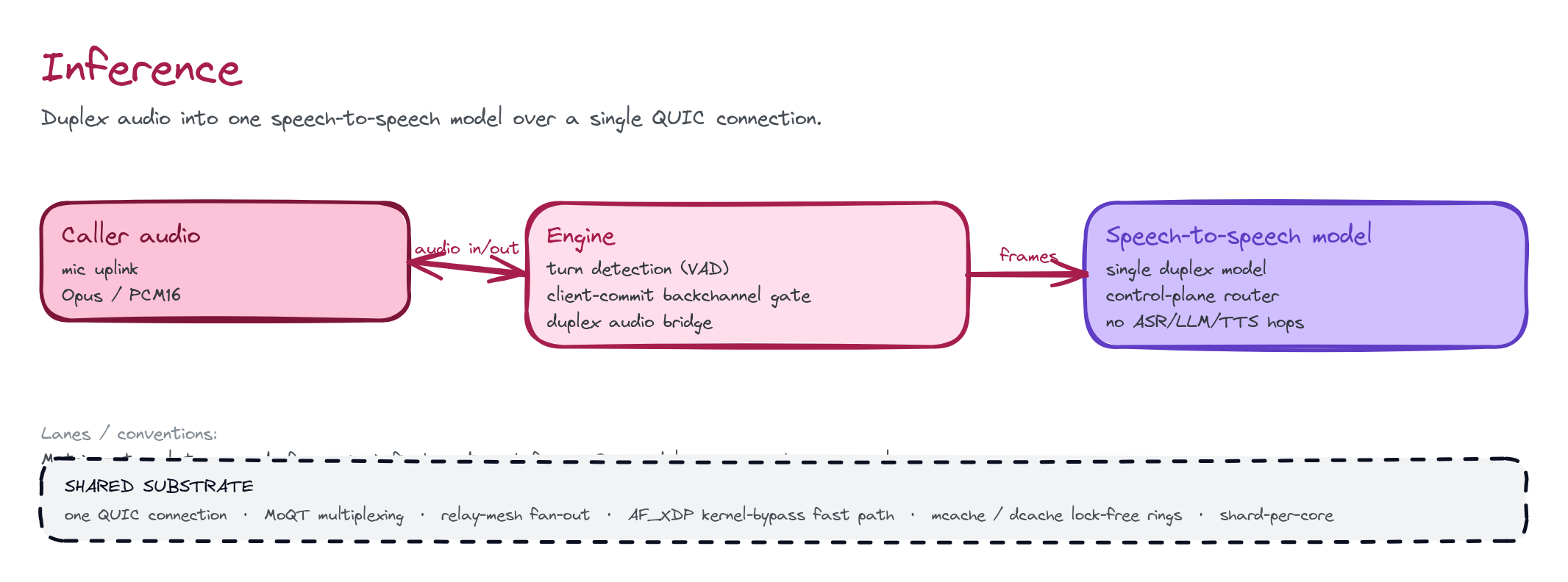
A duplex speech-to-speech turn over one QUIC connection: caller audio in, model audio out, turn detection in the middle.
How the audio flows
The model leg reuses the Voice modality’s track convention. A call carries two audio tracks. The agent attach binds the model to both:There is no “send the whole utterance, then wait” round-trip. Continuous
prefill plus the commit gate (below) gives a near-zero gap between
end-of-speech and the first audio-out frame.
Turn-taking: the client-commit gate
A server-side VAD model decides on its own when your turn ended, and then it starts to talk. A speech-to-speech model has no server VAD. Thus ClutchCall makes the decision of when the user’s turn ended, locally. This is a feature, not a gap: it is the protocol-clean place to gate backchannels. ClutchCall runs a local turn detector over the inbound caller audio and drives the model with explicit signals:1
Append (continuous)
ClutchCall appends caller audio frames to the model’s input buffer at 1x
real-time. The model already “listens” while the caller talks.
2
Prime (open turn)
A non-final commit keeps a turn primed and does not request a reply yet.
The listening window stays open.
3
Commit (end of turn)
When the turn detector decides that a real turn ended, a final commit
flushes the tail. The model then generates its reply. Only a real turn
produces a commit.
Backchannel suppression
Do not treat short continuers (“ok”, “mhm”, “yeah”, “right”) as a turn. The turn detector filters each speech burst shorter thanresponse_min_speech_ms
(default 600 ms). Such a burst never produces a final commit. The model
never wakes up to answer it, and the agent keeps its floor.
Barge-in: hold-and-confirm
Sometimes the caller speaks over the agent. Naive logic cancels the agent on the first speech frame, so a muttered “mhm” mid-sentence kills the whole reply. ClutchCall instead arms a pending barge-in at speech onset. It fires the barge-in only after speech continues forbarge_confirm_ms (default
300 ms). A backchannel ends before the window elapses: there is no cancel,
and the agent keeps talking. A real interruption runs past the window:
ClutchCall cancels the agent, approximately barge_confirm_ms later than a
naive cut. That delay is the only cost.
Codecs
The model wants raw audio. The caller leg can use any codec. ClutchCall transcodes at the bridge. You select what the model expects, and ClutchCall handles the call leg for you.The metric that matters: turn latency
The number that a caller feels is turn latency:turn latency = end-of-user-speech (last inbound audio frame) → start-of-agent-speech (first outbound audio-out frame)Report p50 / p95 / p99, not only the mean. The tail is the product story. Two properties of this modality drive turn latency down:
- Continuous prefill. The model hears the utterance as it streams, so the final commit only flushes the tail. The first audio out can land within tens of milliseconds of end-of-speech.
- QUIC under load and loss. Over a WAN-emulated link (50 ms RTT, ~1% loss), steady-state QUIC first-token latency is approximately half of TCP+TLS, with a much cleaner p99 tail. There is no head-of-line blocking when a packet drops mid-turn.
Tool calling
A speech-to-speech agent is not only a voice. It can act. ClutchCall exposes function (tool) calling to the model:- You declare a set of tools on the agent.
- The model decides to call one tool mid-conversation.
- ClutchCall runs the tool.
- ClutchCall feeds the result back to the model, and the model speaks the answer.
AgentSpec mirrors the same shape. Each tool
advertises a name, a description, and a JSON-schema for its arguments. This is
what the model sees. ClutchCall runs the call. It feeds the structured
result back as a tool_result that the model can reason over.
Tool kinds
Built-in vs operator tools
Every agent session automatically advertises a set of built-in telephony tools: transfer the call, place it on hold, send DTMF, and so on. The model can use them with no configuration. The tools that you declare on the agent are operator tools. On a name collision, the operator tool wins. Thus a tool with a built-in name overrides the built-in tool.silent controls whether the model narrates the call. With silent: false,
the model can say “let me look that up”. With silent: true, it stays quiet
until it has the result.
The full operator spec lives in Agent DAGs. It covers
every field of a tool entry, the auth shapes, and the template substitution
rules. The SDK Methods page
documents the inline ToolSpec that you attach with an agent.
How it works
You do not have to think about these items to ship an agent. But if you chase the tail latency, these items keep it low.- Your agent stays responsive because stages overlap. The model works on the audio that it already heard while the caller still talks. The connection model and the commit gate make that overlap safe.
- A dropped packet never stalls the conversation. Uplink audio, downlink audio, and control signals (commit / cancel) use independent MoQT streams over one multiplexed QUIC connection. A loss on one stream does not hold up the others.
- Reconnects stay cheap for callers at the edge. A tuned QUIC ingress terminates the caller’s connection and forwards to the model-serving fabric. The model’s routing brain (cache-aware / prefix-aware worker selection) stays untouched behind the ingress. 0-RTT resumption keeps reconnect churn low.
- Latency holds even under load. The audio fast path runs a kernel-bypass NIC path with lock-free mcache / dcache rings on a thread-per-core reactor and io_uring. Per-turn transport overhead stays in the low single-digit milliseconds, even at hundreds of concurrent turns.
When to use it
Use inference when
You want a single speech-to-speech model in the loop and the lowest
possible turn latency. You want prosody preserved end-to-end. You want
ClutchCall to own turn-taking and barge-in.
Use the cascade when
You need a specific ASR vendor, a text LLM with tools/RAG, or a particular
TTS voice. The Turn Detection path chains
ASR → LLM → TTS with the same barge-in policy.
Related
- Voice — Details — the call control and audio bridge that this modality uses
- Turn Detection & Barge-In — VAD modes, the cascade path, and the per-vendor support matrix
- Inference — SDK Methods — attaching an agent and the turn-detection knobs